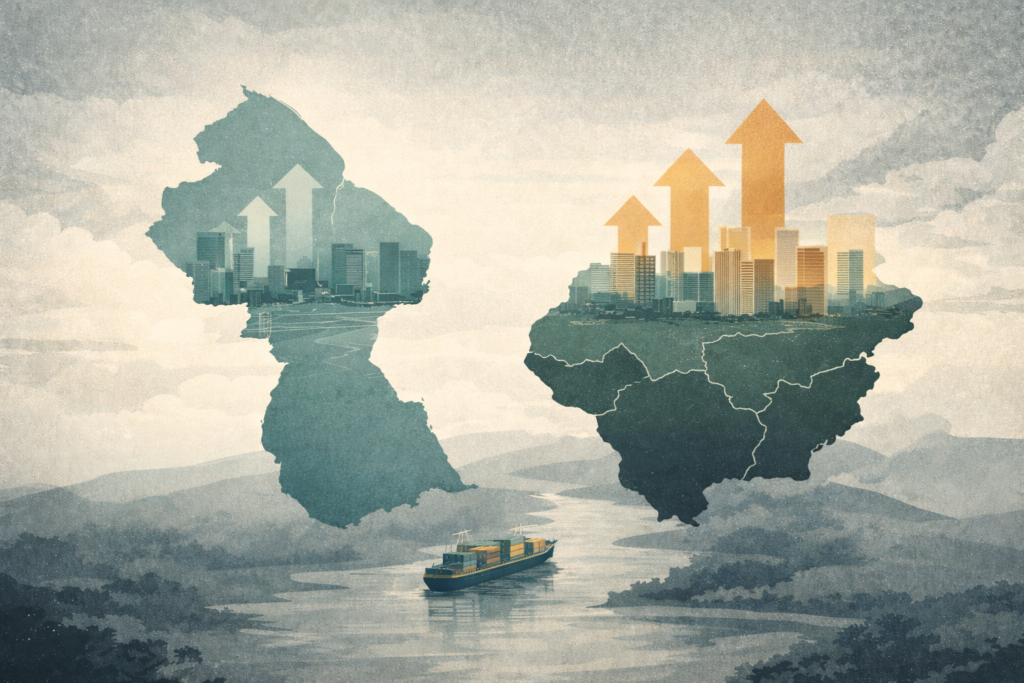
Guyana and Suriname are increasingly positioned as complementary growth poles, driven by energy development, infrastructure expansion, and improving regional integration across northern South America.
Economic developments in Guyana and Suriname are reshaping growth dynamics along the northern edge of South America. While each country follows a distinct development path, shared structural trends—energy investment, infrastructure modernization, and institutional reform—are creating opportunities for economic complementarity rather than competition.
Guyana’s growth has been propelled by capital inflows, public infrastructure expansion, and rising private-sector activity. Suriname, meanwhile, is advancing fiscal consolidation while positioning itself for renewed investment in energy and logistics.
Together, the two economies are strengthening cross-border trade potential, particularly in energy services, construction, transportation, and professional services. Improved port infrastructure, road networks, and digital connectivity are lowering barriers to regional commerce.
Over the medium term, deeper cooperation could reinforce northern South America’s role as an emerging investment destination within the Atlantic basin.